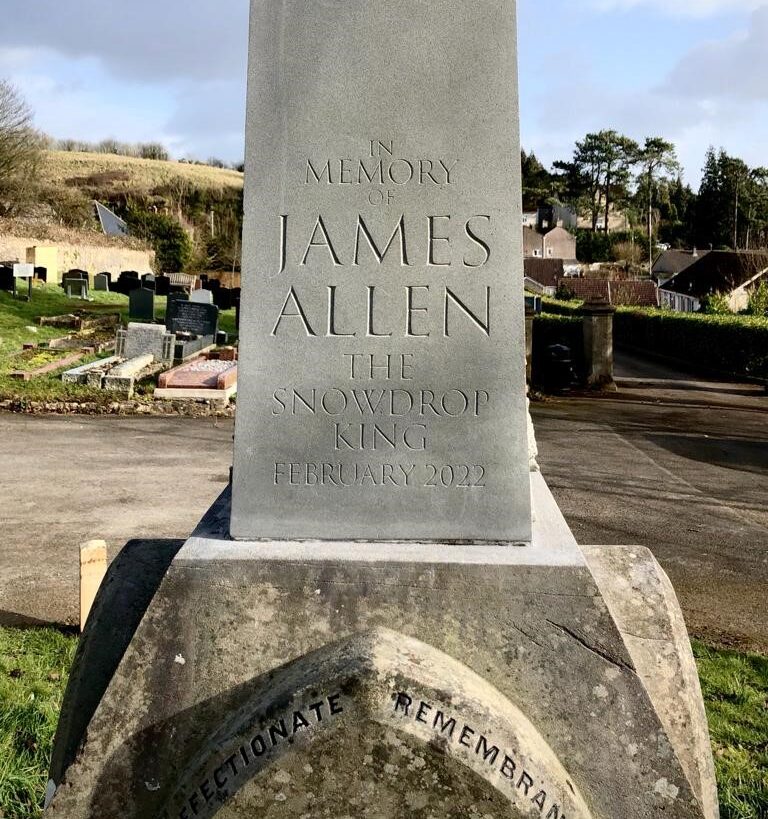
James Allen, the Snowdrop King
James Allen was a self-taught horticulturalist and the first person to breed new varieties from wild snowdrops.
In the late 19th century breeding snowdrops became highly fashionable and James Allen was one of Britain’s most well recognised hybridisers. He grew all the species and varieties known at the time and was probably the first person to deliberately cross and raise hybrids from seed.
He undertook this work at his home in Shepton Mallet. It’s thought there were more than 500 cultivars of snowdrops at this time, and Allen is credited with breeding at least 100 of them. His notes and correspondence are held in the archives of the Royal Horticultural Society.
Galanthus ‘Merlin’ and ‘Magnet’
Sadly, a fungal infection of Botrytis followed by an attack of Narcissus Fly seriously blighted Allen’s snowdrop collection and destroyed much of it. Not all was lost however; two of the varieties he bred at his home in Shepton Mallet – ‘Merlin’ and ‘Magnet’ – still survive to this day.
Merlin’s inner flower segments are completely green, and Magnet has an unusually long stalk so its flowers wave gently in the breeze. The Royal Horticultural Society has given both Magnet and Merlin the Award of Garden Merit – only 28 snowdrop varieties out of 1000s have received this.
In recognition of James Allen’s great achievement and passion for the snowdrop flower, gardeners, snowdrop enthusiasts and volunteers continue to plant snowdrops across the town of Shepton Mallet, in gardens, schools, parks and other public places.

James Allen’s name is also carried by a wood anemone, Anemone nemorosa ‘Allenii’, and Scilla x allenii, which are also commercially available.
Early life
James Allen was born in 1830 at Windsor Hill Mill, just outside Shepton Mallet, and lived there for the next 20 years or more, helping his mother and brother John to run the mill which ground corn for bread and animal feed. During the Bread Riots of 1842 the mill came under attack but James’ brother, John, then aged 18, persuaded the rioters to leave promising to give flour the following morning to those who came from Shepton Mallet.
In 1853 James married Ellen Burt, the daughter of a prosperous local draper, and a year later after their eldest son was born they settled at Park House in Shepton Mallet where he was to indulge his passion for snowdrops.
A public spirited man
James Allen played a prominent role in the town’s affairs. By the age of just thirty-one he became High Constable for a year, which marked the pinnacle of his civic activities. The business occupied some of his time after that but he became increasingly absorbed in his garden and snowdrops.
In an article for The Garden in January 1886, he described how he had put together his collection:
“For the past seven or eight years I have paid special attention to Snowdrops, and by purchasing, exchanging, and the kindness of generous amateurs, I think I possess every variety now in cultivation. I have paid as high as 7s. 6d. (around £34.95 today) per root for new kinds, but for the rarest forms I am indebted to the late Rev. Harpur Crewe, M. Max Leichtlin, and Mr Sanders…. I am constantly purchasing from fresh sources, and then making selections from them when in bloom …. In addition to this, I am raising seedlings from my best varieties.”
A great galanthophile
James Allen is widely recognised as one of the greatest galanthophiles. A very successful plantsman, he was also a pragmatist; he too experienced the successes and disappointments that many fellow plant enthusiasts will recognise today. As he commented: “in raising seedlings of snowdrops one meets with many disappointments.” Of course he had a great deal of success as well, “intense pleasure” from watching his seedlings grow more than compensated for the frustrations. When you are once “in the swim” , he said, time passes from one season to another as some of one’s seedlings will be ”coming out”.
From the 1880’s James suffered from ill health and died in 1906. He is buried just outside the chapel at Shepton Mallet Cemetery alongside his family. In February 2022 a new obelisk, carved with some of the flowers he bred, was reinstated by the Snowdrop Project with the generous and kind support of many individuals and organisations including Mendip District Council and the people of Shepton Mallet.
* We are indebted to Jane Kilpatrick and Jennifer Harmer for some of the material included here, taken from their remarkable book ‘The Galanthophiles – 160 years of snowdrop devotees’